Building the Bank: behind-the-scenes of our new exhibition, ‘Building the Bank’

Hear from the Museum team about their experiences creating our new exhibition
Published on 22 January 2026

Blog

Jennifer Adam, Curator and Alice Beagley, Exhibitions Manager

Why this exhibition, and why now?

The Bank of England was rebuilt (with Herbert Baker as chief architect) in 1925. The site was demolished in three phases (amazingly, much of the work took place whilst staff were still working in the building) and mostly completed by 1939.

When it was built, banking business was done in-person so the building was designed to be much more open to visitors, with many parts beautifully decorated and rich in symbolism about the Bank’s purpose and value. This extended from the massive stone sculpture of Britannia guarding the entrance to the Bank and the spectacular mosaics to small functional objects like air vents and doorhandles. 

The Bank of England was a private company when it was rebuilt (it wasn’t nationalised until 1946) so had more leeway to commission such work. A public building of this scale and grandeur could never be created today. The architecture, artistry and craft involved is something to celebrate and share – these are public artworks, after all. 

So how did we put the exhibition together?

Our main challenge was working out how to distil the decoration and grandeur of an entire building (which is largely off-limits to the public) into a few display cases inside one of the only public spaces in the Bank: its Museum! We wanted to make sure the exhibition content was accessible in different formats and receive input from a variety of people. To address this, we created an audio guide which discussed some of the architectural themes explored in the exhibition, set up an engagement group with Bank staff, and consulted subject specialists to help us form a well-considered narrative about the building and its history.

So what’s on display?

All sorts: from architectural plans, artwork, and archaeology, to archival video footage, a still from the game Assassin’s Creed, and everything in between! Read on for some of the exhibition’s key themes... 

The Bank’s ever-changing site:

The Bank sits on a site which was originally part of Roman London - it’s been a hive of activity and trade for more than two thousand years. 

During the rebuilding, excavations uncovered a variety of objects, including Roman mosaics, mediaeval pottery and glass, and clay tobacco pipes from the 1700s – all showing how trade has brought different products to London.

Above: The Roman mosaic when it was first discovered (BoE Archive: 15A13/1/2 (135)), and in its current location at the bottom of the Bank’s cantilever staircase, designed by Herbert Baker and installed in 1936.

Another mosaic discovered by Soane in 1809 is on display near the Museum’s Information Desk.

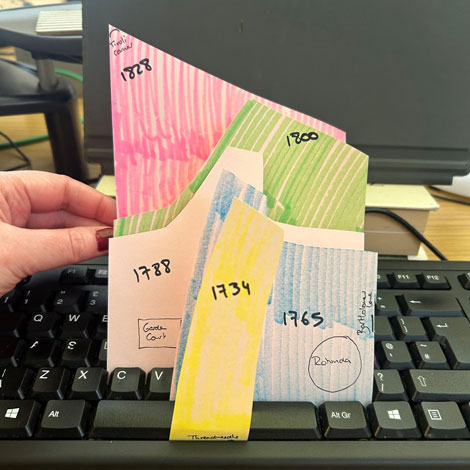
The Bank’s building has also changed significantly over the past 300 years: when we first occupied this site in 1734, the building was about a fifth of the size it is today. Using a 3D layered approach, we created a display (affectionately nicknamed ‘the toast rack’), made up of different architectural plans of the building, where each ‘slice’ fits neatly into its own ‘slot’! It’s not all CAD drawings though – sometimes these things start life as humble post-it notes...

Above: the concept (in the form of layered post-its), the different layers before they were installed (with each architectural ‘phase’ outlined in a different colour), and the finished product.

The building and the surrounding area are constantly evolving; we’re in the process of  getting a new roof, looking towards what the building needs to equip us for the next few decades, and recent changes to Bank Junction have made the area easier to navigate for pedestrians and cyclists. A huge amount of work goes into these changes, and yet they are still little more than a blink in this area’s long and varied history.

Celebrating our building’s architecture, art and crafts:

Herbert Baker’s (and his predecessors’) designs of the Bank were both heavily influenced by classical architecture. Many parts of the building are lavishly decorated and steeped in symbolism, both classically inspired and more modern in style. Collectively, they celebrate a wealth of technical and creative expertise.

Sculptures by Charles Wheeler gave a modern feel to Baker’s neoclassical design; Boris Anrep’s mosaics (many of which depicted coins minted at significant points in British history) add splashes of colour amidst the monochrome Belgian marble and limestone; and Joseph Armitage’s plasterwork added beauty to otherwise functional designs.

Above: ‘The Builders’, by Alfred Kingsley Lawrence, depicts members of the Bank’s building committee. Herbert Baker is seated in the centre, and Charles Wheeler is wearing white overalls and a red bandana. The Bank of England is visible in the background. (BOE Museum 1087).

Sharing these can be tricky, since they’re in a part of the Bank the public can’t usually access. So we installed a true-to-size reproduction of one of Anrep’s larger mosaics (depicting lions guarding a pillar of gold) as a floor covering to give visitors an idea of their scale and rich details.

The mosaic floors of the Bank are an artwork in their own right: it took Anrep’s team ten years to design, make and lay them, and it’s estimated that around 7 million tiles (tesserae) were used to cover an area of 770 square meters!

Above: section of mosaic pattern created by the London school of mosaic; Anrep’s lion mosaic, and its freshly-laid vinyl counterpart!

Baker outlined his vision for the design and decoration of the Bank through an enormous quantity of drawings now cared for by the Bank of England’s Archive. Below is a sketch showing a section of the ground floor and the rough designs of the mosaics envisioned by Baker – you can just about see the design for the lion mosaic in the dark circle!

(BoE Archive 20A20/118)

We also had the mosaic (as well as a lovely brass doorknob sculpted by Charles Wheeler) 3D printed so they could be handled by visitors with visual impairments. These were very well received at our World Sight Day Event and we look forward to using them more in future engagements to support our accessibility offering.

Visit our exhibition in the Bank of England Museum to discover more of the Bank’s hidden architectural treasures, decoration and history.

Can’t visit in person? Explore some of the objects from our exhibition on Flickr!