
New Bank Start-up Unit

The New Bank Start-up Unit provides information and support for those thinking of setting up a new bank in the UK.

Introduction

Firms that want to operate as banks in the UK (see ‘thinking of becoming a bank’ section) must be authorised by the Prudential Regulation Authority (PRA), with the consent of the Financial Conduct Authority (FCA).

International banks seeking to establish a banking subsidiary and/or branch in the UK should, in parallel with referring to the NBSU website, consult SS5/21 (International banks: The PRA’s approach to branch and subsidiary supervision), as well as the FCA’s Approach to international firms publication.

The New Bank Start-up Unit (NBSU) is a joint initiative set up by the UK financial regulators, the PRA and the FCA, to provide information and support for firms interested in, or currently applying for, authorisation as a bank in the UK.

To advance the PRA and FCA’s primary and secondary objectives (information on the PRA’s objectives, goals and latest business plan. Information on the FCA objectives, both regulators will assess whether a firm meets the Threshold Conditions, which are the minimum standards that all firms must meet at their point of authorisation, and on an ongoing basis while operating as a bank.

The Threshold Conditions for the PRA and FCA (below) are set out in Schedule 6 to the Financial Services and Markets Act 2000.
    • Legal status: Deposit-takers must be corporates or partnerships;
    • Location of offices: A UK incorporated corporate body must maintain their head offices and, if one exists, their registered office in the UK;
    • Prudent conduct of business: The firm must conduct their business in a prudent manner, which includes having appropriate financial and non-financial resources;
    • Suitability: The firm must satisfy the PRA that they are a ‘fit and proper’ person with regard to all circumstances to conduct a regulated activity; and
    • Effective supervision: The firm must be capable of being effectively supervised by the PRA.
    • Effective supervision: The firm must be capable of being effectively supervised by the FCA;
    • Appropriate non-financial resources: The firm’s non-financial resources must be appropriate in relation to the regulated activities they seek to carry on, having regard to the FCA’s operational objectives;
    • Suitability: The firm must be a fit and proper person. The firm’s management must have adequate skills and experience and act with integrity (fitness and propriety). The firm must have appropriate policies and procedures in place, and it must appropriately manage conflicts of interest; and
    • Business model: The firm’s strategy for doing business must be suitable for a person carrying on the regulated activities it undertakes or seeks to carry on and must not pose a risk to the FCA’s objectives.

Thinking of becoming a bank in the UK?

A ‘bank’ is an entity that carries out deposit-taking business. The PRA and the FCA glossaries define a ‘bank’ as a firm with a Part 4A permission, which includes accepting deposits and is a credit institution, but is not a credit union, friendly society, or building society.

The Financial Services and Markets Act 2000 (Regulated Activities) Order 2001 defines the regulated activity of accepting deposits (see Chapter II Accepting Deposits) and stipulates that, to accept deposits, one of the following statements must be true:

a) Money received by way of deposit is lent to others or;
b) A firm uses deposits to materially fund a business line.

Firms must consider if their proposed business satisfies the definition of accepting deposits and be able to justify this assessment to regulators. You should also consider the following:

    • Firms should consider their options for accessing payment systems as early as possible and adequately reflect this in their plans. Payment systems are critical to allow the transfer of funds between people, businesses and financial institutions – new banks are unlikely to be able to operate without access to a payment system. The NBSU encourages firms to consider the guidance on payment systems access.
    • New banks can access a payment system in the following ways:
    • Full direct access – where the new bank will have a direct technical and settlement relationship with the payment system provider (PSP);
    • Direct technical access – where the new bank will have a direct technical relationship with the PSP but use a sponsor for settlement; or,
    • Indirect access – where an Indirect Access Provider (IAP) acts as the new bank’s sponsor for both technical and settlement sponsorship.
    • There are a variety of software vendors with products and services that may reduce the cost and complexity of the direct access option, as well as several IAPs providing indirect access offerings. Further information about direct and indirect access can be found on the Payments Systems Regulator and Payment System Operators’ websites, and in the Code of Conduct for Indirect Access Providers.
    • If the firm is already FCA solo-authorised (for example an investment firm seeking to broaden their funding base to take on retail deposits), they will need to apply to vary their permissions to add deposit-taking. Whilst this is a different regulatory transaction, the firm should follow the same authorisation process as fully unauthorised firms. In this instance, the NBSU recommends that, like unauthorised firms, the solo-regulated firm should follow the pre-application stages before applying to become authorised. In addition, the NBSU encourages FCA solo-authorised firms seeking dual authorisation to consider their capital and ownership structures and ensure that those are as simple as possible.
    • The use of certain sensitive words such as ‘bank’ and ‘banking’ in registered company names is controlled by legislation to prevent the public from being misled. Firms cannot call themselves a ‘bank’ until they have been authorised by the PRA. Prospective firms must take care when liaising with press, prospective investors, and posting on social media, prior to obtaining authorisation.
    • Firms may begin the application process as ‘Example Ltd’ but only once they are authorised as a bank can they call themselves ‘Example Bank Ltd’.
    • Firms must seek the FCA’s consent before using domain names that include sensitive words including ‘bank’ and ‘banking’. Further information can be found on the FCA’s sensitive business name page.
  • Please refer to ‘Should I become a bank’ guide to help firms understand whether being a bank is the appropriate model for them.

    Are there alternatives to being a bank?

    Yes, please refer to the ‘alternatives to being a bank’ guide for further information on some of the alternatives.

    The NBSU is open to listening to proposals and answering any questions you may have - before any significant work has been undertaken towards becoming a bank in the UK.  If you have a proposal that you would like to raise or discuss, please email NewBankstartupunit@bankofengland.co.uk with your proposal/enquiry – someone from the team will get back to you within five working days.

Engaging with the NBSU

To navigate the authorisation process as efficiently as possible and achieve their objective of setting up a bank, firms should be ready, willing and organised. We have provided below some examples of how firms can demonstrate this. Please note that this is not an exhaustive list:

  • Ready and thinking ahead – Firms should ensure that they have a well thought through proposition which has undergone robust challenge and consideration of the inherent risks (this should also be appropriately reflected into their key documents). Firms should ensure that they will have in place appropriately skilled staff and operational infrastructure to commence trading at the point of being authorised. This includes a robust IT framework, a robust governance framework, risk management framework, premises, and finances;
  • Willing – Firms should demonstrate that they have done their research, understanding not only the activities that they will be undertaking but the rules and regulations which their business will be governed by; and
  • Organised – Firms should ensure that they are operationally ready to carry out the regulated activities at the time of their authorisation (if successful).

We aim to have positive regulatory relationships with firms along their journey, from pre-authorisation to becoming authorised and later becoming established banks. We do this by keeping an open and constructive dialogue:

    • Be open and honest;
    • Have considered the guidance provided on this website
    • Provide all the necessary information to undertake our assessments
    • Notify us of any changes, challenges or concerns as soon as possible
    • Develop plans, complete the necessary work, and prepare and send materials in good time for meetings with us;
    • Fully consider and address the feedback we provide on key documents such as the Regulatory Business Plan (RBP)/the Internal Capital Adequacy Assessment Process (ICAAP)/the Internal Liquidity Adequacy Assessment Process (ILAAP) documents
    • Understand, consider and demonstrate how they will meet the required standards at authorisation and on an ongoing basis.
    • To clearly set out the process and requirements for setting up a bank;
    • To host pre-application meetings to discuss the firm’s proposals and highlight any concerns;
    • To provide firms with clear feedback on their proposals including formal written feedback;
    • We will end our pre-application engagement with firms if our feedback is not adequately addressed in the development of their proposition and key documents
    • To help firms understand the standards required of being an authorised bank.

New Bank Pre-application engagement

(Optional but recommended)

The NBSU offers firms a ‘complimentary service’, which includes enhanced engagement and support as firms build out their proposals before applying for a banking licence.

Although pre-application engagement is optional and not part of the statutory authorisation process, it is something that the NBSU encourages firms to take advantage of at an early stage (feedback from previous applicant banks has shown how valuable they have found it).

Early engagement allows the NBSU to provide input into the development of regulatory business plans, by guiding potential applicants towards what the PRA and FCA are most interested in, as well as helping them understand regulatory requirements. It also allows the NBSU to identify any significant issues or showstoppers at an early stage.

Pre-application engagement with the NBSU is usually focussed around three stages (although this is flexible and all three stages might not be necessary):

i. business proposition;
ii. draft regulatory business plan; and
iii. technical sessions.

If you would like to take advantage of this complimentary pre-application engagement service, then please contact NewBankstartupunit@bankofengland.co.uk.

  • Although still early in a firm’s preparations, you will have reached the stage where you can present (usually as a PowerPoint presentation) high level information on your business model, financial forecasts, governance, source of funding, ownership, controllers and risks. You should also provide an indication of the timeframes that you are working towards and indicate whether you will be applying for full authorisation or authorisation with restrictions (also known as mobilisation), as this will impact your planning, as well as the information requirements for your application.

    Upon receipt of your business proposition, the NBSU will review and schedule a meeting, typically within three weeks from date of receipt (this meeting may be over MS Teams so progress can be made as efficiently as possible). You will also receive written feedback within three weeks of the meeting.
  • The RBP forms a critical component of the assessment of a potential application, and therefore the NBSU expects your RBP to already be at a detailed stage prior to submission and should include the following:

    • Business model and financials covering business strategy, route to profitability, financial projections;
    • Market analysis and research that underpins the business model assumptions;
    • Corporate governance setting out board and committee structure as well as proposed approach for recruiting senior managers;
    • Risk register and stress testing;
    • Risk management and control framework;
    • Funding plans, which includes details around the owners and controllers. Where funding is still being sought, you should provide details of your plan to bring in investors;
    • Conduct risk of harm and consumer duty (if applicable);
    • Financial Crime Risk Management Framework;
    • Operational resilience covering outsourcing, IT infrastructure timescales to implement/test and business continuity;
    • Details of the regulated activities you wish to undertake (please refer to the application form for further information on the regulated activities that can be applied for);
    • Mobilisation plan (if applicable);

    Please refer to the Regulatory Business Plan guide for further information on why an RBP is important, what should be included and the common challenges.

    Once you have submitted your RBP (it is useful to be notified of the planned RBP submission date two weeks in advance), the NBSU will review and schedule a face-to-face or hybrid MS Teams meeting, typically within three weeks from date of receipt. You will also receive written feedback within the three weeks following the meeting.

  • At this stage, the expectation is that you have addressed all the feedback provided and can submit a fully developed RBP. For UK start-ups and subsidiaries of international banks, you will also have drafted and submitted your ICAAP and ILAAP documents by this stage. 

    The firm’s management team should own ICAAP and ILAAP and be able to discuss these in detail at the technical session. The ICAAP and ILAAP should have gone through a full review and challenge by someone other than the author (the Board or the key guiding minds of the firm), before they are submitted to the NBSU.

    At this stage, the PRA will assess the ICAAP and ILAAP, which includes engagement with the relevant technical specialists. The assessment will focus on whether the ICAAP and ILAAP meet the relevant regulatory expectations and consider whether the documents would be sufficient to set capital and liquidity requirements during an application.

    The NBSU will also consider the latest RBP to assess if there is any further feedback prior to the firm submitting the application. Further, depending on the nature of the proposed business model and operational design, the FCA may also look to hold focused technical sessions on the financial crime control framework.

    Following the submission of the near final RBP, ICAAP and ILAAP, the NBSU will schedule a face to face or hybrid MS Teams meeting. Typically, this will be within six weeks from date of receipt. As this review involves technical specialists, it is important to give both the PRA and FCA as much notice as possible prior to submitting, and to provide at least two weeks' notice, so that both regulators can line up the necessary resource and avoid delays. You will also receive written feedback within three weeks of the meeting.

Submitting the application

The application process commences with the submission of the New Firm Authorisation application (and supporting documentation), and the payment of the PRA and FCA’s non-refundable application fee. It is entirely up to the firm to decide when it should submit its application, but this should be at a point where the firm can demonstrate that their business is ready, willing and organised to be authorised as a bank. 

There are two routes available for applying to be a bank in the UK: 

  • Full authorisation; or
  • Authorisation with restrictions (mobilisation) – this route is primarily targeted at UK start-ups. Although the Threshold Conditions still need to be met, the NBSU’s approach to the information requirements will be proportionate to the restrictions that will be put in place, and therefore will likely result in a quicker authorisation (the information instead will be required during the mobilisation period and will be assessed as part of the application to remove the restrictions).  Please refer to the further information on mobilisation.

The application forms

Please note, firms will need to send an email with an electronic copy of their application (and supporting documentation) to the PRA at the following mailbox: NewBankstartupunit@bankofengland.co.uk.

If the file size exceeds 25 MB, please use multiple emails to accommodate your submission.

The application fee

The PRA and the FCA Regulatory Transaction fees for applications for new authorisations are payable in accordance with PRA Rulebook and FCA Handbook.

The total fee payable (covers both PRA and FCA fees) to seek permission to accept deposits (other than a credit union) is £55,740.

The preferred method for payment is via BACS to the FCA, who will provide a single invoice covering both the PRA and FCA fees.

Please make the payment to the FCA using the details below:

Account name: FCA Collection account
Bank name: Lloyds Bank
Account number: 00828179
Sort code: 30-00-02
Swift code: LOYD GB 2LCTY
Iban code: GB68 LOYD 3000 0200 8281 79.

When you make the payment, please reference it with the following: Title: ‘New authorisation application’ and the ‘firm name’ (name of the firm applying for authorisation).

Please then email your remittance advice and payment details to: fcafees@fca.org.uk and NewBankstartupunit@bankofengland.co.uk.

Information on how to pay the fee is also contained within the application form.

Please note that in the case of a firm withdrawing its application, and later re-submitting another application, they would likely need to pay the full fee again.

The authorisation (including decision making) process

The NBSU will acknowledge receipt of your application within two working days.

Usually, the NBSU will communicate whether your application is complete or incomplete within three weeks of receiving it (if incomplete, the regulators will inform you of any missing information).

  • For complete applications (i.e., the NBSU has received the application fee and all the necessary applications and supporting documents, which should be of sufficient quality and detail for completion of the assessment) – the PRA has a voluntary service level agreement of up to four months to determine the application (with a statutory timeframe of within six months)
  • For incomplete applications – the PRA has a voluntary service level agreement of up to ten months to determine the application (with a statutory timeframe to assess within twelve months).

During the assessment period the NBSU welcomes regular dialogue and encourages you to reach out as and when you need. The NBSU will keep you informed on the progress of any reviews and proactively highlight any significant risks or issues identified. In addition, the NBSU will typically meet monthly with the firm’s senior management.

The PRA aim to issue a decision as quickly as possible, but this depends on how complete your application is and how promptly you respond to our requests for information. We may have questions or need more details from you during our assessment. Responding quickly and thoroughly will help speed up the process.

The decision-making process:

  • Both the PRA and FCA will independently decide whether to authorise your bank.
  • Without FCA consent, the PRA cannot authorise your bank

If authorised, you'll receive:

  • An authorisation letter
  • A Scope of Permission Notice detailing your permissions and any requirements
  • A welcome pack
  • Your bank’s details will be added to the Financial Services Register on the date shown in the authorisation letter.
  • Initial notification
    If during our assessment of the application we think there are grounds for refusing your application, we'll inform you both verbally and in writing where you'll have time to address our concerns.

    Minded to refuse letter
    If you can't address the concerns, we'll send you a letter explaining why and which rules or threshold conditions haven't been met.

    At this point you can either withdraw your application (and reapply later when issues have been addressed) or, if you want to proceed, the PRA and FCA will follow its decision-making process

    Issuing statutory notices (Warning Notices and Decision Notices)
    Please refer to SoP1/24 - The Prudential Regulation Authority’s allocation of decision making and approach to supervisory decisions, which sets out

    • the PRA’s allocation of decision-making regarding statutory notices (Warning Notices, Decision Notices, and Supervisory Notices);
    • the PRA’s approach to decision-making on statutory notices in relation to supervisory decisions under the Financial Services and Markets Act 2000; and
    • the PRA’s approach to publication of decisions in supervisory cases.

Regulatory expectations as part of the assessment approach

The assessment – full authorisation

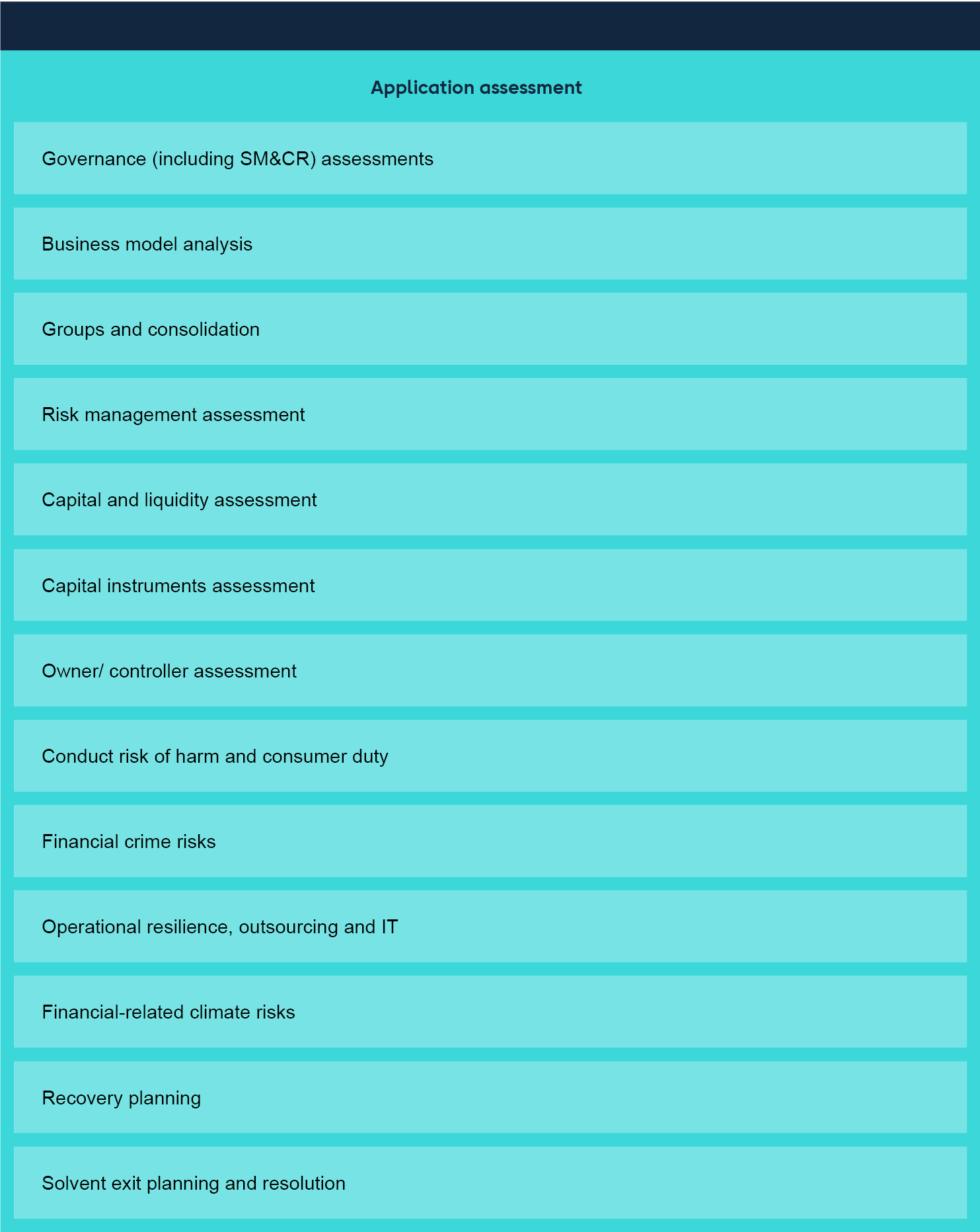
The areas that the NBSU assess as part of a new bank application are set out below but should not be considered an exhaustive list. Firms are responsible for considering in detail all relevant laws, rules and regulatory policies, and ensuring that they understand and can fully comply with them.

Read information on ‘regulatory expectations’ (including where expectations are different for branches)

The assessment – authorisation with restrictions (mobilisation)

It is up to firms to propose to the NBSU which activities they complete in mobilisation (please refer to the application form for details of the activities that can be applies for). Therefore, the key for the NBSU’s assessment is that all the design work is complete with a clear plan to deliver everything with a plausible timeframe.

Further information is contained within the mobilisation page.


Life as an authorised bank (with restrictions - mobilisation)

Once a new bank is authorised with restrictions, it enters a mobilisation period, which typically lasts no longer than 12 months. During this time, the bank's deposit-taking permission is restricted to a total of £50,000, while it completes the remaining build-out of its operations. This period allows new banks to secure further investment, recruit staff, invest in IT systems, and commit to third-party suppliers, as they are now an authorised bank.

Further information is contained within the mobilisation page.

    • The PRA and FCA anticipate that new banks will want to progress quickly through the mobilisation phase. This could take as little as a few months but cannot continue indefinitely and should take no longer than 12 months. For a new bank to exit mobilisation, they should submit a Variation of Permission (VoP) application via Connect.
    • Further information is contained within the mobilisation page.
  • Further information is contained within the mobilisation page.

Life as an authorised bank (without restrictions)

At this stage, the firm should be fully operational and in a position to fulfil its business proposition as agreed with the PRA and FCA. 

  • Authorisation is only the start of the journey towards becoming an established bank.
  • New banks must always meet their capital and liquidity regulatory requirements and the Threshold Conditions.
  • New banks must ensure that they submit their regulatory returns on time and keep up to date with the latest regulatory information.
  • New banks must ensure that risk management frameworks and controls evolve commensurately with the scale of business growth.
  • The PRA and FCA will assess how new banks are managing the key prudential and conduct risks, respectively, to their businesses through supervisory engagement.
  • Read: Life as an authorised bank (without restrictions).

Resource links, new banks authorised since 2013 and contact details

  • 16 March 2026 – Refreshed more concise NBSU website, updated application forms and regulatory expectations (including new section on group and consolidated supervision).  Guides on Regulatory Business Plans and Mobilisation have been created (linked within this page)
This page was last updated 18 March 2026