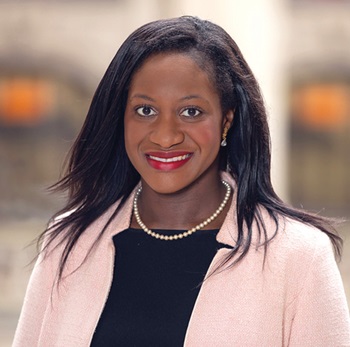
Speech
Thank you to the Chairman, Alderman Prem Goyal, Alderwomen, Aldermen, Chief Commoner and distinguished guests.
Thank you to the City of London and Guildhall for this invitation to speak on a timely and highly relevant topic: getting fit for the future.
Introduction
This is my first speech of the year. As we crossed over into the New Year, one of the things on my mind was, how am I going to get fit? It is uncannily similar to the question that has been at the heart of how we evolve the Bank of England’s strategy and operations, to help support the UK economy. We are transforming our infrastructure, delivering modern core central banking and prudential regulation. We are building muscle by investing in skills and technology.
So, while our staff gym at Threadneedle Street is feeling the January rush from people like me, the Bank too, is building strength and flexibility. We are building a Bank that is fit for the future.
For nearly seven years, I have been the Chief Financial Officer (CFO) of the Bank of England. I care deeply about our values and our purpose. And like any CFO, am passionate about the purse strings… and achieving Value for Money. As Audit and Risk Committee members in the audience will appreciate, governance is key to safeguarding the Bank’s reputation. We are part of the public sector, and our accountability is not to shareholders, but to Parliament and the public.
People are often surprised when I say that the Bank has 5,700 employees, an £800 billion balance sheet, and generates £5 billion of annual revenues.footnote [1] What is particularly important to me is that our strong values and integrity are the heartbeat of the Bank of England.
Modernising Our Financial Framework
Since I joined the Bank, I have focussed on modernising the Bank’s financial framework. Integral to this, there are four key pillars, which I am going to talk to you about:
1) Balance sheet strategy
2) Investment and Funding strategy
3) Innovation and Digitisation
4) People strategy
1) Balance Sheet strategy
Starting with the big numbers, the size of our balance sheet peaked at £1.1 trillion during the pandemic and now stands at £800 billion.
While a commercial bank’s balance sheet size is determined by commercial choices, ours has been driven by policy choices. We need to ensure that there are sufficient liquid reserves in the system to deliver financial stability, as well as via interventions like Quantitative Easing and the Term Funding Scheme for Small and Medium Enterprises (TFSME). These policy choices are driven by the Bank’s objectives.
The future size of our balance sheet size will be largely determined by liquidity “demand” rather than “supply”.footnote [2] In the recent past, reserves have been supplied by the Bank to the market, mainly via asset purchases. Going forward, demand will be met primarily by repo operations.footnote [3] The quantity of reserves the Bank supplies is now being determined by market (Sterling Monetary Framework participants’) demand for reserves in the Bank’s facilitiesfootnote [4], against a broad range of collateral, including mortgage-backed securities and loan portfolios. We have over £160 billion of repos on the balance sheet so far.
Balance sheet strength
The Bank’s balance sheet is strong because of the Capital and Risk Management Framework that we hold with His Majesty’s Treasury (HMT), our 100% shareholder. This has 2 key features:
Firstly, the Bank has a £3.5 billion capital target. This reflects accumulated profits that we have built up over time and also includes a £1.2 billion capital injection received from HMT in 2018. This capital is public money, which the Bank can use to back our operations, and we manage this prudently within our well-developed risk framework.
Secondly, the Bank has an indemnity with HMT in regard to our Asset Purchase Facility (APF). The APF is a wholly owned subsidiary of the Bank.
Since the Global Financial Crisis, the Bank has had to undertake large scale monetary and financial stability operations in the face of multiple economic shocks. These operations include Quantitative Easing, which is decided by the MPC, but also financial stability interventions to support the gilt market in 2022. The risk of these operations could crystallise either a profit or loss. The scale of these operations could cause a financial risk to materialise that could not have been supported by the Bank’s own capital. So instead, these have been conducted through the APF, which is indemnified by HMT. While the indemnity has allowed policymakers to focus on the monetary and financial stability policy implications of their interventions, the Bank’s operations, which implement these decisions, maximise value for money by minimising cost and risk over the lifetime of the APF.footnote [5]
As the Bank’s CFO, I am on the Board of Directors of the APF. Each quarter, I am one of two Director signatories responsible for signing off on the two-way cash flows between the Bank and the Treasury that result from the financial consequences of policy decisions. While the Bank sent £123 billion to HMT before 2022, cash flows have been moving the other way since then. These cashflows are publicly reported, and the quarterly Asset Purchase Facility reports provide more detail on how they could evolve in future. footnote [6]
2) Investment and Funding strategy
Like many organisations, the Old Lady of Threadneedle Street (Old Lady) needs to invest in upgrading obsolete systems and in cutting-edge innovation to drive better outcomes for society. We have a multi-year strategic investment plan to help us build muscle to support our operations. When we need to invest in our critical national infrastructure to deliver a better service, and change our levies and tariffs, we consult with industry first. And to be able to pay for investment in our core systems and data, we make budget cuts; this requires efficiencies and productivity in our day-to-day work. As we become more efficient, we are strategically rebalancing our cost base, from labour to capital. This means reducing headcount. We are currently running a mutually agreed, time-limited scheme for staff to choose to apply to leave the Bank. We are committed to ensuring the Bank is efficient, resilient and fit for the future.
During the Global Financial Crisis, I was an investment banker at UBS and then became a CFO at Barclays, doing Group Cost transformation and growing the Mortgages business. In fact, Alderman Sir Peter Estlin was our esteemed former CFO at Barclays, and my boss. I am grateful that he supported me when I joined the Bank, during his term as Lord Mayor. I also learned a lot from Shaygan Kheradpir, my other boss; esteemed former Barclays Chief Operating & Technology Officer and Silicon-Valley innovator and Tech-guru.
Since joining the Bank, I have come to realise that the Bank is no different to commercial businesses in needing to manage its costs carefully. We must spend responsibly. As we transform the Bank, I have found there is a common thread with our approach and that in the private sector:
- putting customers at the heart of decisions
- delivering a better customer experience and
- staying ahead of the competition.
You may know that the Bank’s primary objective is to deliver good outcomes for the public as a whole, by maintaining monetary and financial stability. You may or may not know that through our committees, the Bank has secondary objectives to support government economic policy. For example, the Prudential Regulation Authority (PRA) has two secondary objectives: a secondary competition objective and a secondary competitiveness and growth objective.
Funding strategy
It is my job to think about how to pay for what we need to deliver to meet our objectives, and how much our levies should be to industry. When it comes to our £5 billion of income, you may wonder how the Bank makes so much money.
Firstly, we generate about £4 billion seigniorage income annually (at current market rates) from the production and management of Bank Notes. This £4 billion annual income is paid over from the Bank to HMT as required by the 1844 Bank Charter Act.
Secondly, the Bank has a £1 billion income stream from our levies, tariffs and our balance sheet.
We have agreements in place that set out how any surplus income earned beyond our expenditure, is to be shared between the Bank and HMT, our 100% shareholder.footnote [7] The level of dividend payment ensures that the Bank can retain enough income, so we have the capital resources in place to achieve our monetary and financial stability objectives.
Impact of Transforming the Bank’s funding
Moving to the nuts and bolts of the funding, one of the things I am most proud of is that we have transformed the Bank’s funding mechanism. Almost two years ago, we introduced the Bank of England Levy through primary legislation, terminating our legacy loss-making Cash Ratio Deposit (CRD) scheme.footnote [8] I was particularly pleased, as this change means all our costs are now fully recovered. This provides transparency and certainty to the firms we levy and is an improvement on an historic approach. I didn’t like the old scheme, as it made no direct link between our policy expenditure and income.
The legislative changes to our funding have allowed us to now have more direct regard to “who pays” for all of our different services. But I would say that the number one benefit of all this, is that it allows us to constrain our budget by capping our income growth. We are actively constraining the costs that we charge industry. Value for Money is key.
3) Innovation and Digitisation
Moving away from the numbers...our future success will be driven by our talented people and our adoption of cutting-edge technology.
The Old Lady of Threadneedle Street has a long history of embracing technology and innovation to deliver its core mandate. In 1805, we used a wind dial to predict how soon ships would arrive in London and therefore when trade would expand, and with it the demand for money.footnote [9]
When it comes to innovation and digitisation, the upgrade of Real Time Gross Settlement system (RTGS) has taken centre stage at the Bank and has been a piece of world-leading infrastructure in Central Banking. In fact, RTGS is UK critical national infrastructure and settles over £790 billion of payments a day! We were delighted when the new system went live last year. The Bank will recover the investment costs over 20 years from tariff payers. I am a member of the RTGS Executive Board, and my focus was on Value for Money as we developed the new system.
In December 2025, the National Audit Office (NAO) published a review of the RTGS Renewal programme.footnote [10] Quoting the report: “The programme demonstrates good practice and innovation, which could be instructive for other digital projects as well as for the Bank’s wider project management.” “The Bank has identified lessons from the renewal programme that it could apply to its wider management of transformation projects.”
The NAO highlighted that the key positives contributing to the programme’s success were:
- Strong governance and accountability
- Upfront investment in the design phase
- An open culture and strong stakeholder engagement
- Thorough testing
Emerging technologies
As we get fit for the future, Artificial Intelligence (AI), Quantum technologies and Distributed Ledger Technology are the 3 cross-cutting technologies that we are prioritising, given their potential for transformative outcomes.footnote [11] We began incorporating traditional AI methods into our work around 2014. We have started to apply Machine Learning to forecast UK inflation, financial crises, and bank distress. We are using generative AI to improve staff productivity and to support policymaking. The size and sophistication of models and the accessibility of solutions to everyone, creates a complex system of humans and machines. This raises questions around acceptable use, ethics, and highlights issues around data privacy and security.
Ensuring operational resilience and responding to current and emerging cyber threats are an important part of our strategy, as well as being a key feature of how the PRA supervises firms. Careful thought therefore is needed on guardrails and the risks emerging technologies can introduce.
4) People strategy
It’s all well and good having cutting edge technology, but I firmly believe that the real strength and uniqueness of the Bank of England comes from our fantastic people. The Bank of England is a hotbed of talent.
Culture
Our culture is the lifeblood of our organisation. At the Bank we encourage our colleagues to open up about things affecting their wellbeing, at work or at home, and help them to manage the challenges in a variety of ways. We also have a strong speak up culture. We have an environment, where we can support our staff, and bring out the best in them. Our 14 staff networks provide a powerful voice to build collective understanding of issues, and to advocate where change and support are most critically needed.
Diversity, Equity and Inclusion
Continuously improving our Diversity, Equity and Inclusion (DEI) is fundamental to our people strategy and our values. I was delighted to be appointed co-Executive Sponsor for DEI by Andrew Bailey in 2021. It’s pretty simple in my opinion. We want to attract and retain the best people. We need to embrace all visible and invisible differences to help us represent the make-up of society, when we are making complex, collective decisions that influence every household and business in the UK.
Did you know that 5 out of the 9 members of our Monetary Policy Committee (MPC), who set interest rates, are women? And that our Executive Committee is 50% women, 50% men?
After I joined the Bank seven years ago, I discovered that I was the most senior black executive in the Bank’s 331-year history.
And today, 3 of our 11 Court Directors are ethnically diverse, and 17% of our senior managers are ethnically diverse.
What I would say is that while progress is being made, we know we have more work to do to meet our targets by 2028. These were published in the Court Review on Ethnic Diversity.footnote [12]
Regional differences across the UK also matter. We rely on insights from our 12 regional agencies, and we currently have over 200 colleagues based in Yorkshire House, our Leeds office.
What I can say is that the Bank is steadfast in our values; and we remain committed to making progress on diversity and inclusion.
Leadership
When it comes to leadership, my personal observation is that the Bank of England breeds leaders. I am proud that staff who have walked through the doors of Threadneedle street have real influence in the world around us. This is a beacon of inspiration for our staff, who are building their careers.
I have personally witnessed leaders, who have worked at the Bank, and then gone on to become Governors, Chancellors and Prime Ministers, influencing in the UK and on the world stage. These include:
1) Our Governor, Andrew Bailey, is Bank of England homegrown and also Chair of the Financial Stability Board, representing Central Banking at the G20.
2) The UK’s first female Chancellor, Rachel Reeves.
3) Theresa May, the UK’s second ever female Prime Minister.
4) And internationally, Mark Carney, the Prime Minister of Canada, our former Governor.
Conclusion
To conclude, I believe that the Bank of England is a place where all can thrive, where all can succeed, and where all can drive change. It is through harnessing our differences, that we can build resilience and grow as a society.
So, as January comes to an end, I am excited about what is still to come. I am optimistic and hopeful about what the future holds. The Old Lady is transforming. The Bank is building its strength and flexibility. The Bank of England is getting fit for the future.
Thank you for listening.
I would like to thank my colleagues, Thomas Knight, Robyn Dwyer, Rhys Phillips, Paul McArdle, Rafael Kinston, Rebecca Estrada-Pintel and Victoria Saporta for their helpful comments in preparation of this speech.
-
‘Financial Statement highlights’, Bank of England Annual Report and Accounts 1 March 2024-28 February 2025, p 39.
-
Learning by doing − speech by Victoria Saporta | Bank of England
-
Let’s get ready to repo! - speech by Victoria Saporta | Bank of England
-
The evolving liquidity landscape − speech by Victoria Saporta | Bank of England
-
Letter from the Governor to the Chancellor on the Asset Purchase Facility - November 2025
-
Asset Purchase Facility Quarterly Report - 2025 Q3 | Bank of England
-
Memorandum of Understanding Between HM Treasury and the Bank of England 2025 | Bank of England
-
Bank of England's Real-Time Gross Settlement System Renewal Programme, National Audit Office.
-
Court Review of Ethnic Diversity and Inclusion | Bank of England