Mortgage Lenders and Administrators Statistics - 2025 Q3

The Mortgage Lenders and Administrators Return (MLAR) is a quarterly statistical release aggregated from data on mortgage lending activities provided by around 340 regulated mortgage lenders and administrators.
Published on 09 December 2025

Key findings

  • The outstanding value of all residential mortgage loans increased by 0.9% from the previous quarter to £1,733.7 billion, and was 2.9% higher than a year earlier (Table A).1
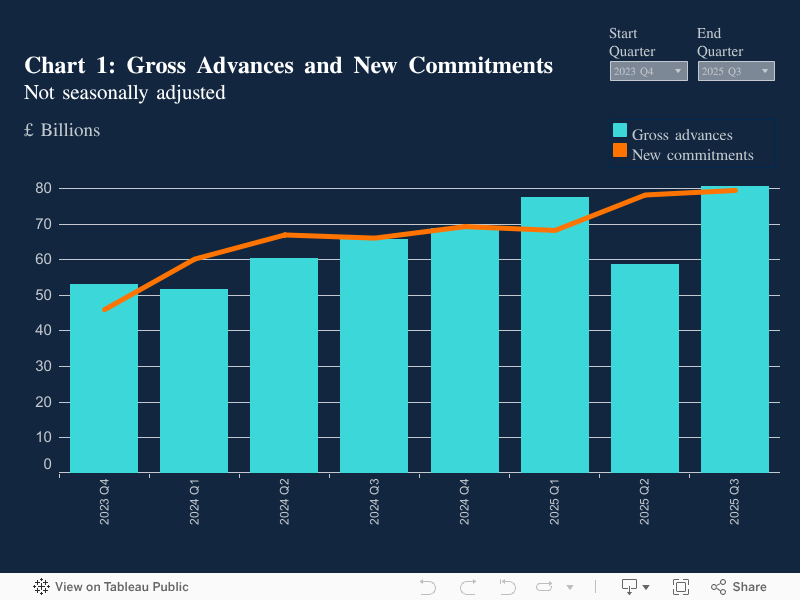
  • The value of gross mortgage advances increased by 36.9% from the previous quarter to £80.4 billion, the largest increase in new advances since 2020 Q3, and was 22.7% higher than a year earlier (Table A and Chart 1).
  • The value of new mortgage commitments increased by 1.6% from the previous quarter to £79.4 billion, the highest since 2022 Q3, and was 20.3% higher than a year earlier (Table A and Chart 1).
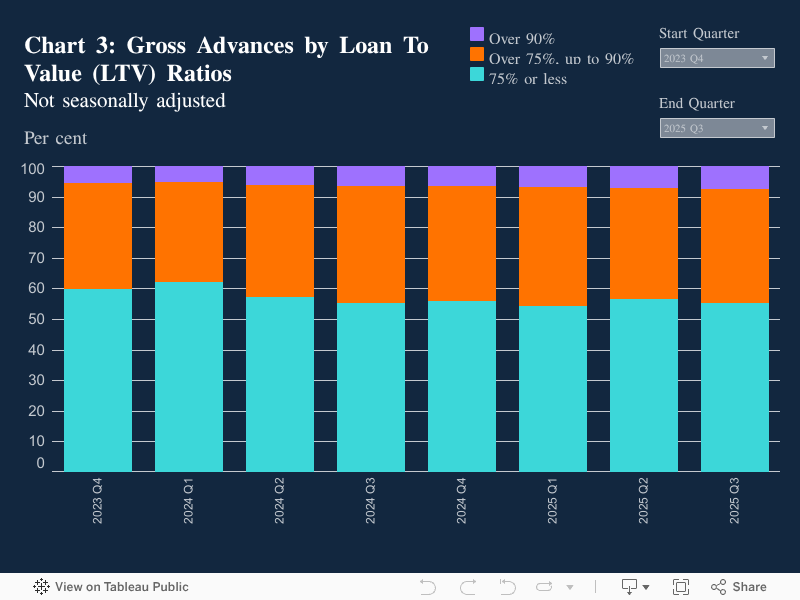
  • The share of gross mortgage advances with loan-to-value (LTV) ratios exceeding 90% increased by 0.3 percentage points (pp) from the previous quarter to 7.4%, the highest share since 2008 Q2, and was 0.8pp higher than a year earlier (Chart 3).
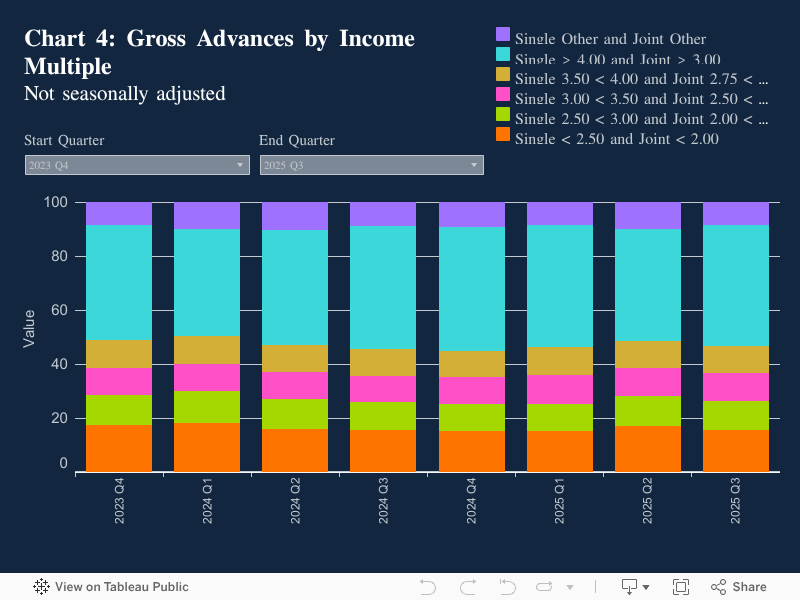
  • The proportion of lending to borrowers with a high loan-to-income (LTI) ratio increased by 3.3pp from the previous quarter to 44.7%, the largest increase since 2020 Q3, but remained 0.6pp lower than a year earlier (Chart 4).
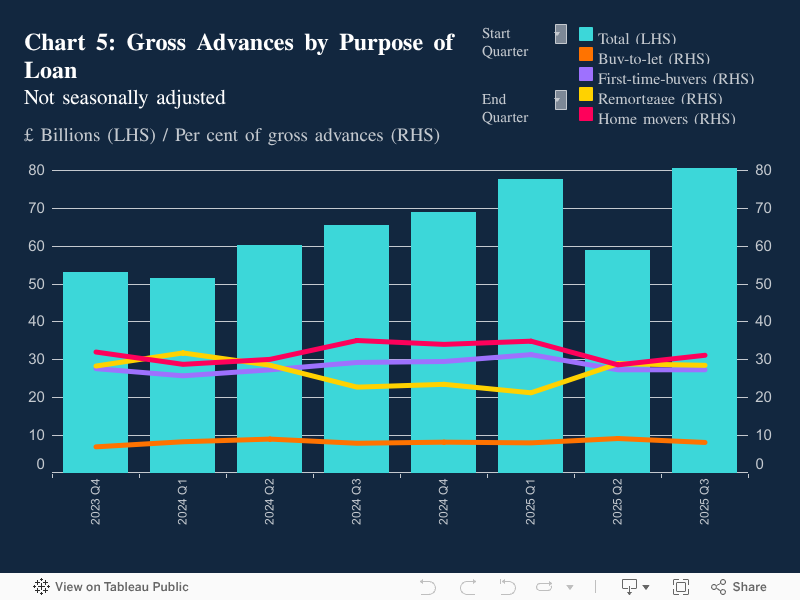
  • The share of gross mortgage advances for house purchase for owner occupation increased by 2.5pp from the previous quarter to 58.6%, but remained 5.8pp lower than a year earlier. (Chart 5).
  • The share of gross advances for remortgages for owner occupation decreased by 0.4pp from the previous quarter to 28.6%, but remained 5.8pp higher than a year earlier (Chart 5).
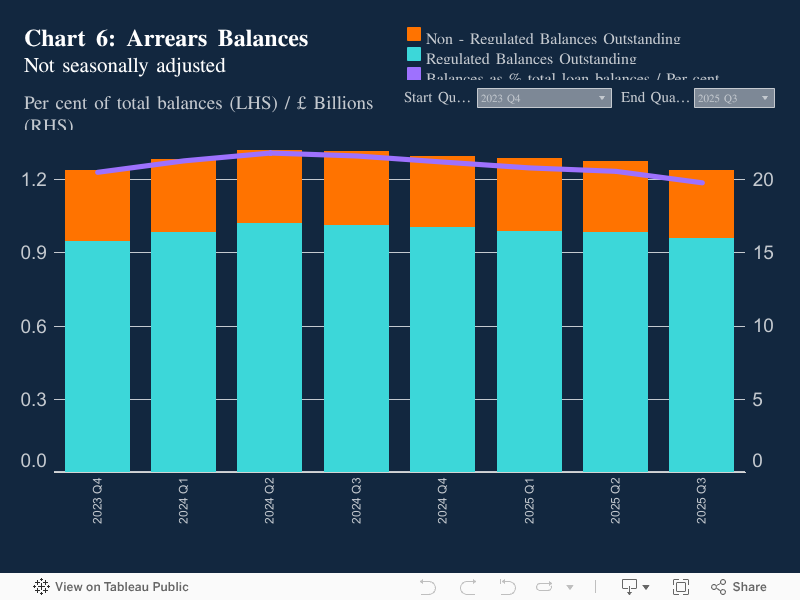
  • The value of outstanding mortgage balances with arrears decreased by 2.9% from the previous quarter to £20.6 billion, and was 5.8% lower than a year earlier (Chart 6).
  • The proportion of the total mortgage loan balances with arrears, relative to all outstanding mortgage balances, has stayed the same as the previous quarter at 1.2%, and was 0.1pp lower than a year earlier (Chart 6).
  • The proportion of total outstanding balances with arrears that are new arrears cases decreased by 0.1pp from the previous quarter to 8.8%, the lowest since 2022 Q1, and was 0.9pp lower than a year earlier.

Table A: Residential loans to individuals, flows and balances

Regulated and non-regulated mortgages *

£ billions

Not seasonally adjusted

Q4

Q1

Q2

Q3

Q4

Q1

Q2

Q3

2023

2024

2025

Flows

Gross advances

52.9

51.6

60.2

65.5

68.8

77.6

58.8

80.4

New commitments

46.0

60.2

66.9

66.1

69.3

68.2

78.2

79.4

Amounts outstanding

1,671.8

1,670.0

1,676.3

1,685.5

1,693.2

1,713.3

1,718.1

1,733.7

*This data covers regulated mortgage lending, and non-regulated mortgage lending by firms which undertake regulated mortgage lending or administration of regulated mortgages.

Graphical Analysis:

  • The value of gross mortgage advances increased by 36.9% from the previous quarter to £80.4 billion, the largest increase in new advances since 2020 Q3, and was 22.7% higher than a year earlier (Table A and Chart 1).2
  • The value of new mortgage commitments (lending agreed to be advanced in the coming months) increased by 1.6% from the previous quarter to £79.4 billion, the highest since 2022 Q3, and was 20.3% higher than a year earlier.3
By loading the chart you agree to Tableau cookie policy. This use will include analytics.

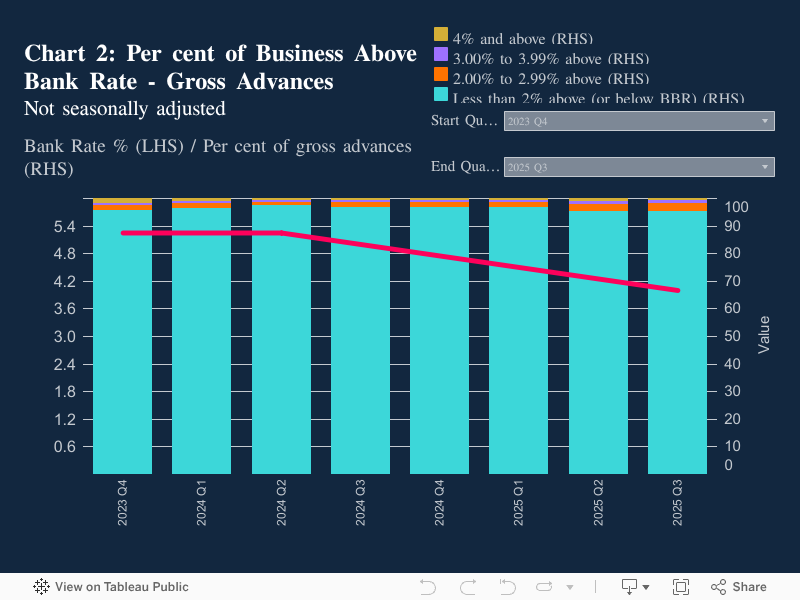
  • The share of gross mortgage advances with interest rates less than 2% above Bank Rate (including at or below Bank Rate) increased by 0.4pp from the previous quarter to 95.5%, but remained 1.4pp lower than a year earlier (Chart 2).4
  • The share of advances with interest rates between 2% and up to 3% above Bank Rate decreased by 0.1pp from the previous quarter to 2.7%, but remained 1.1pp higher than a year earlier.5
  • The share of advances with interest rates 3% or more above Bank Rate decreased by 0.2pp from the previous quarter to 1.8%, the first decrease since 2024 Q2, but remained 0.3pp higher than a year earlier.6

By loading the chart you agree to Tableau cookie policy. This use will include analytics.

  • The share of gross mortgage advances with LTV ratios exceeding 90% increased by 0.3pp from the previous quarter to 7.4%, the highest share since 2008 Q2, and was 0.8pp higher than a year earlier (Chart 3).7
  • Within this, the share of mortgages advanced with LTVs over 95% has stayed the same as the previous quarter at 0.5%, and was 0.2pp higher than a year earlier.8
  • The share of gross mortgage advances with LTV ratios exceeding 75% increased by 1.2pp from the previous quarter to 44.6%. This was the same as a year earlier.9

By loading the chart you agree to Tableau cookie policy. This use will include analytics.

  • The proportion of lending to borrowers with a high LTI ratio increased by 3.3pp from the previous quarter to 44.7%, the largest increase since 2020 Q3, but remained 0.6pp lower than a year earlier (Chart 4).10 Borrowers with high LTI ratios are defined here as:
    • Borrowers with a single income and an LTI ratio of 4 or above. This proportion increased by 0.8pp from the previous quarter to 10.9%, the largest increase since 2024 Q3, and was 1.4pp higher than a year earlier.11
    • Borrowers with a joint income and an LTI ratio of 3 or above. This proportion increased by 2.4pp from the previous quarter to 33.8%, the largest increase since 2020 Q3, but remained 2.0pp lower than a year earlier.12

By loading the chart you agree to Tableau cookie policy. This use will include analytics.

  • The share of gross mortgage advances for buy-to-let purposes (covering house purchase, remortgage and further advance) decreased by 1.0pp from the previous quarter to 8.2%, the largest decrease since 2024 Q3, but remained 0.2pp higher than a year earlier (Chart 5). The share of advances to owner occupiers was 91.8%.13,14
  • Of the 91.8% of advances for owner occupiers, the share of gross advances for remortgages for owner occupation decreased by 0.4pp from the previous quarter to 28.6%, but remained 5.8pp higher than a year earlier. The share of gross mortgage advances for house purchase for owner occupation increased by 2.5pp from the previous quarter to 58.6%, but remained 5.8pp lower than a year earlier. Further advances and other mortgages (including lifetime mortgages) decreased by 1.1pp from the previous quarter to 4.7%, the largest decrease since 2016 Q3, and was 0.1pp lower than a year earlier. 15,16,17
  • Of the 58.6% of advances for house purchases by owner occupiers, lending to first time buyers has stayed the same as the previous quarter at 27.4%, but remained 1.9pp lower than a year earlier. The share advanced to home movers increased by 2.5pp from the previous quarter to 31.2%, but remained 3.9pp lower than a year earlier. 18,19

By loading the chart you agree to Tableau cookie policy. This use will include analytics.

  • The value of outstanding mortgage balances with arrears decreased by 2.9% from the previous quarter to £20.6 billion, and was 5.8% lower than a year earlier (Chart 6).20 Arrears are defined as the borrower failing to make contractual payments where the balance owed is equivalent to at least 1.5% of the outstanding mortgage balance or where the property is in possession.
  • Of the £ 20.6 billion of outstanding mortgage balances with arrears, the value of non-regulated mortgages (including buy-to-let loans and other residential lending to individuals where the property is not for use by the borrower or qualifying dependents) decreased by 4.0% from the previous quarter to £4.7 billion, and was 6.7% lower than a year earlier.21
  • The proportion of the total mortgage loan balances with arrears, relative to all outstanding mortgage balances, has stayed the same as the previous quarter at 1.2%, and was 0.1pp lower than a year earlier.22
  • The proportion of total outstanding balances with arrears that are new arrears cases decreased by 0.1pp from the previous quarter to 8.8%, and was 0.9pp lower than a year earlier.23

By loading the chart you agree to Tableau cookie policy. This use will include analytics.

Footnotes

Note on Chart 4: Gross advances by income multiple: The ‘Other’ category is used when the loan assessment is based, only partly or not at all, on one or more persons’ incomes. Further details can be found in the FCA Handbook.

1 Table 1.11 sub table A row 9
2 Table 1.21 sub table C row 1
3 Table 1.21 sub table C row 3
4 Table 1.22 sub table C row 3 (less than 2% above)
5 Table 1.22 sub table C row 4 (2.00% to 2.99% above)
6 Table 1.22 sub table C row 5 + row 6 (3% or more above)
7 Table 1.31 sub table C row 19 + row 20
8 Table 1.31 sub table C row 20
9 Calculated as 100% of all mortgages less those <= 75% LTV (Table 1.31 sub table C row 21 - row 17)
10 Table 1.31 sub table C row 5 + row 13
11 Table 1.31 sub table C row 5
12 Table 1.31 sub table C row 13
13 Table 1.33 sub table C row 4 (buy-to-let)
14 Calculated as 100% of all mortgages less those for buy-to-let purposes (100% - Table 1.33 sub table C row 4) (owner-occupation)
15 Table 1.33 sub table C row 6 (remortgage)
16 Table 1.33 sub table C row 2 + row 3 (house purchase owner occupation)
17 Table 1.33 sub table C row 5 + row 9 (further advance and other)
18 Table 1.33 sub table C row 2 (first-time buyers)
19 Table 1.33 sub table C row 3 (home movers)
20 Table 1.7 sub table C row 10
21 Table 1.7 sub table B row 10
22 Table 1.7 sub table C row 11
23 Table 1.7 sub table C row 4

Queries

If you have any comments or queries about this release please email mlar@bankofengland.co.uk.

Next release date: 10 March 2026

More information

Long run versions of the summary and detailed tables are now available in Excel format, for data going back to Q1 2007. These have been sourced from data published by the FSA on their archive pages prior to Q1 2013 and data published by the Bank of England from Q1 2013.